In this guide
A degree, a professional license, current registration and a certification answer different questions. Read the issuer, scope and timing of each requirement before deciding what evidence you need.
Four categories that should stay separate
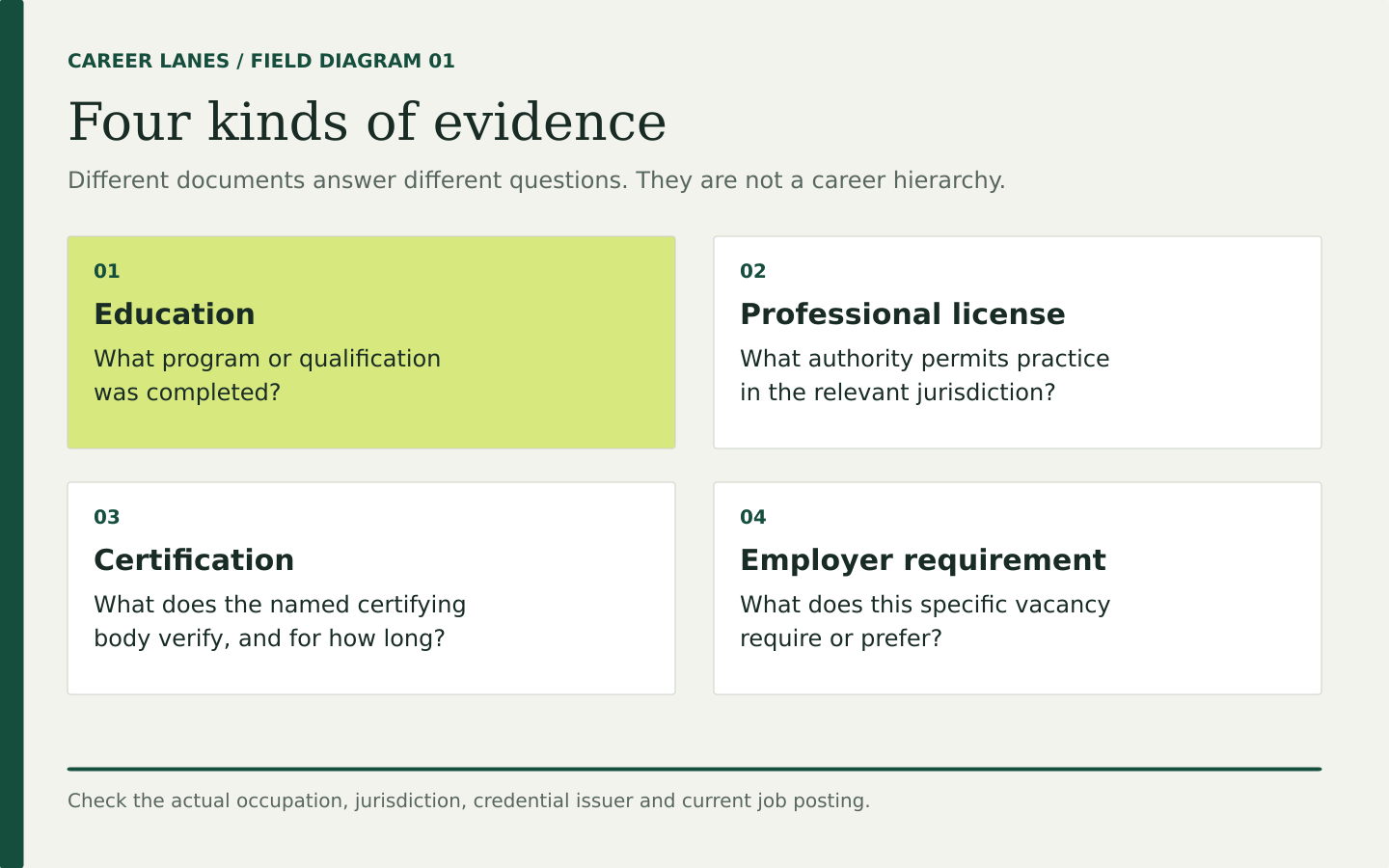
Education records show what you studied and completed. A professional license or state certification concerns authorization within a jurisdiction. Registration can be the current status needed to practice. A professional-body certification may demonstrate a defined competency. An employer requirement describes what a particular vacancy expects. The labels can overlap, so always identify the issuer.
New York’s professional licensing FAQ distinguishes the award of a license from registration to practice. Profession-specific guidance controls the details. The distinction matters when a person holds a license but has not verified current registration. NYSED professional licensing FAQs ↗
The word certification needs a second question
Ask “certified by whom, for what?” New York clinical laboratory technician certification is a state professional authorization. A national credential used in an application route is a separate item. The same word can therefore refer to different evidence. NYSED clinical laboratory technician requirements ↗
For every named credential, record the issuer, exact title, scope, expiration or renewal status and the role requirement it addresses. Do not send those records to this publication. Use your own secure records and the issuer’s official verification route.
If a posting abbreviates the requirement, verify the expansion and accepted issuer rather than choosing the most familiar interpretation. Several similar-sounding certificates may exist. A short training completion certificate may not be the professional credential an employer names.
Required, preferred and after-hire are different
A required qualification should be treated as a requirement unless the employer clarifies an accepted alternative. A preference is relevant to competitiveness but should not be rewritten as an absolute condition. A stated after-hire deadline belongs in a third category, together with its actual timing and conditions.
Consider an editorial example: one posting requires credential A, prefers experience B and says training C occurs after selection. A person should not claim eligibility based on B alone, should not assume the absence of B automatically excludes them, and should not buy an unrelated C course without checking whether it is accepted. This is a reading example, not a Northwell policy.
The same care applies to degree language. A preferred degree, a professional education requirement and a future degree condition serve different purposes. A regulator and an employer may each set requirements within their own authority. Ask the right source about each.
Build a gap list that leads to an answer
Use three statuses: verified, missing and unresolved. Verified means you have matched the actual requirement to current evidence. Missing means a known requirement is not yet met. Unresolved means you need clarification; it is not a quiet pass or a failure.
Then assign each unresolved item to its authority. The regulator can explain professional authorization. The credential issuer can explain its certificate. The school can explain the program. The employer can interpret the vacancy. A mentor can help frame the question, but cannot issue any of those decisions.
Before committing money or changing jobs, check the source again. Requirements and program status can change. Keep the date and the exact page alongside your notes, and avoid treating a remembered rule from a previous application as permanent. This approach is slower than collecting badges indiscriminately, but it produces evidence you can actually use.
Sources and method
This analysis combines public evidence with editorial questions and examples. Suggestions are preparation tools, not employer rules or an eligibility decision. Sources reviewed September 30, 2026.
- NYSED professional licensing FAQs ↗: General New York professional licensure/registration distinctions; profession-specific rules control.
- NYSED clinical laboratory technician requirements ↗: New York state certification; distinct from national certification.