In this guide
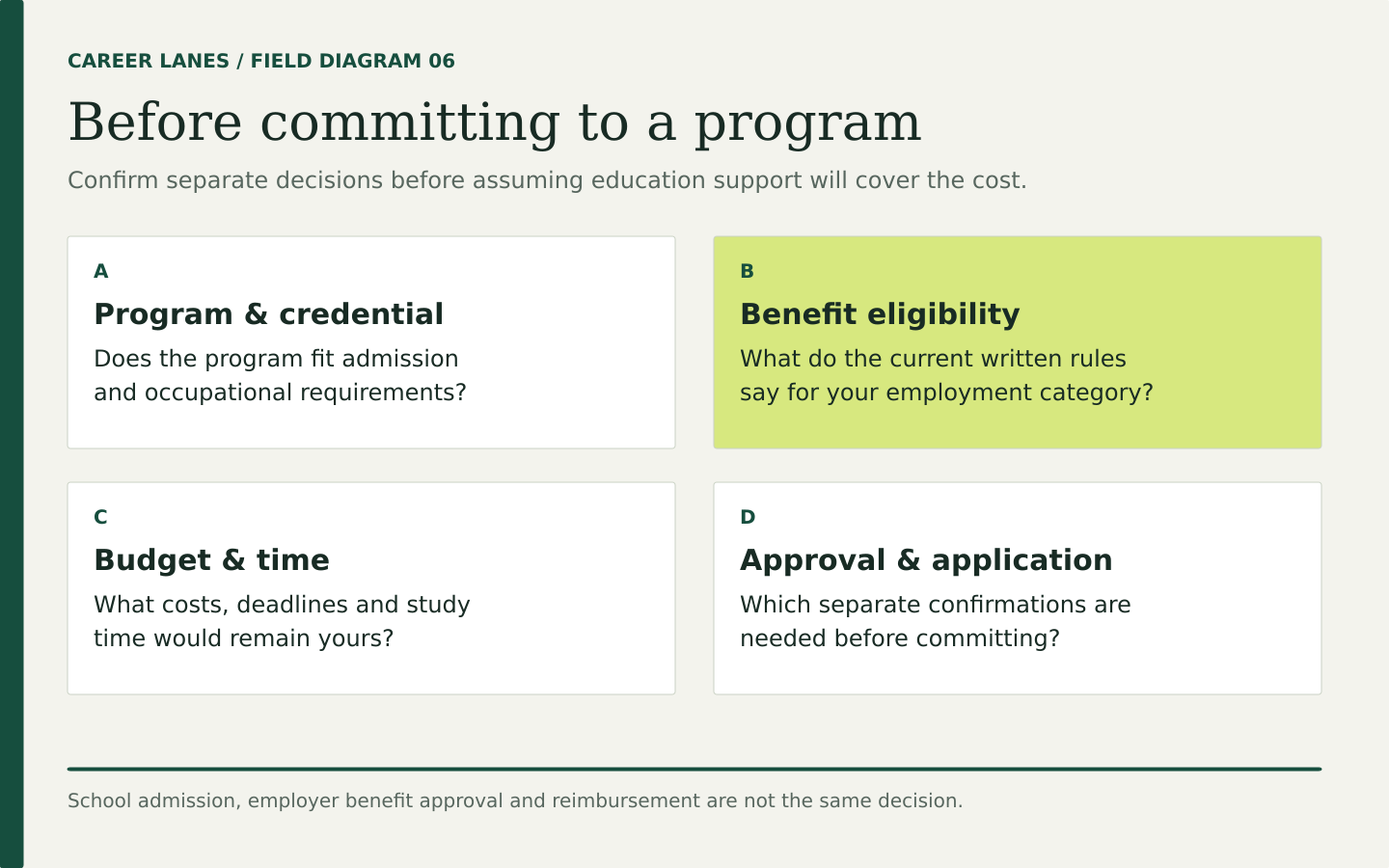
A course is most useful when it closes a defined gap. Connect the program, the target role and the funding conditions before deciding to enroll.
Start at the destination requirement
Choose a target role or profession before choosing a program. Read the exact education and credential requirements, then ask which part of your current preparation is missing. A degree can be valuable for several reasons, but “more education” is too broad to evaluate cost or fit.
For regulated work, verify the professional education route with the regulator. NYSED’s RN guidance explicitly warns prospective students to verify that a New York program qualifies for RN licensure before enrolling or paying. The same disciplined question is useful across professions: which requirement does the program satisfy? NYSED RN license requirements ↗
Do not confuse an academically accredited institution with proof that every program it offers satisfies every professional requirement. Ask about the specific program and your intended jurisdiction. If you have prior education, ask how it will be evaluated rather than assuming all credits transfer.
Keep employer assistance conditional until confirmed
Northwell publicly describes tuition assistance and reimbursement resources for eligible team members. An overview does not confirm your eligibility, approved program, reimbursement timing or continued-employment conditions. Obtain the terms that apply to your situation before treating assistance as committed funding. Northwell benefits overview ↗
Ask which expenses are covered, whether approval is needed before enrollment, what documentation is required and when payment occurs. Ask how your employment status and chosen program affect the answer. These are due-diligence questions; they are not assertions that any particular restriction exists.
Budget the sequence as well as the total
A program can be affordable overall but difficult to fund if payment is due before reimbursement. Make a simple timing plan using confirmed tuition, fees and aid information. Include only amounts you can substantiate, and treat unapproved assistance as uncertain.
Also compare time. Ask the program about classroom attendance, placements, prerequisites and required sequencing. A course labeled part-time may still include periods with fixed attendance. Ask your employer about scheduling through the authorized route rather than assuming flexibility.
Consider what happens if the planned pace changes. A delayed prerequisite or placement can affect later courses. Ask the school about deferral, withdrawal and refund terms before making a commitment. This article does not recommend borrowing or determine whether a particular financial arrangement is appropriate.
Choose between a degree and a narrower learning need
If the target requires a professional degree, a short workshop will not substitute. If the gap is a specific skill, a degree may be more than you need at this stage. A careful comparison can identify whether the missing evidence is formal qualification, demonstrated experience or better communication of work you already do.
Ask a mentor to challenge the link between your intended course and the target role. Then verify any factual claim with the relevant program, regulator or employer. A helpful mentor can improve the question without guaranteeing admission, reimbursement or selection.
Your enrollment decision should be expressible in one paragraph: the target, the requirement, the program’s verified contribution, the funding conditions and the time plan. If those pieces remain vague, use the next week for information gathering rather than treating enrollment itself as evidence that the career plan is settled.
Sources and method
This analysis combines public evidence with editorial questions and examples. Suggestions are preparation tools, not employer rules or an eligibility decision. Sources reviewed September 30, 2026.
- NYSED RN license requirements ↗: New York registered professional nursing requirements; not an individual licensing decision.
- Northwell benefits overview ↗: Public overview; individual eligibility and written benefit terms control.